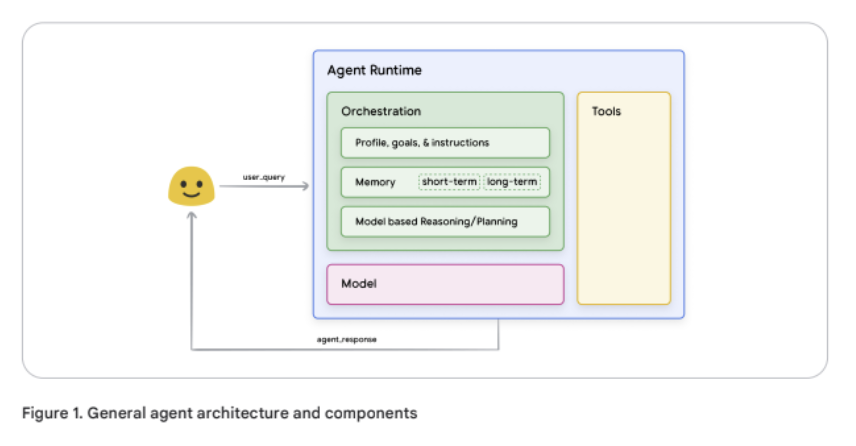
 From the Kaggle paper on Agents.
We see that agents are comprised of:
Orchestration Layer
Stuff like:
- Instructions
- Agent Profiles
- Agent goals and objectives
- Memory (short- and long-term)
- Model-based reasoning and planning, etc
Tools
Types of tools:
- Extensions
- Functions
- Data Stores (Vector DBs) Functions are executed on the client-side, while extensions (what we’d call plugins) are executed agent-side.
Model
The model/LLM must be capable of following instruction-based reasoning and logic frameworks, like ReAct, Chain-of-Thought or Tree-of-Thoughts. They can be general-purpose, multimodal or fine-tuned on a need-to-have basis. Tip: it’s good to fine-tune the agents with the specific tools or reasoning steps in various contexts.
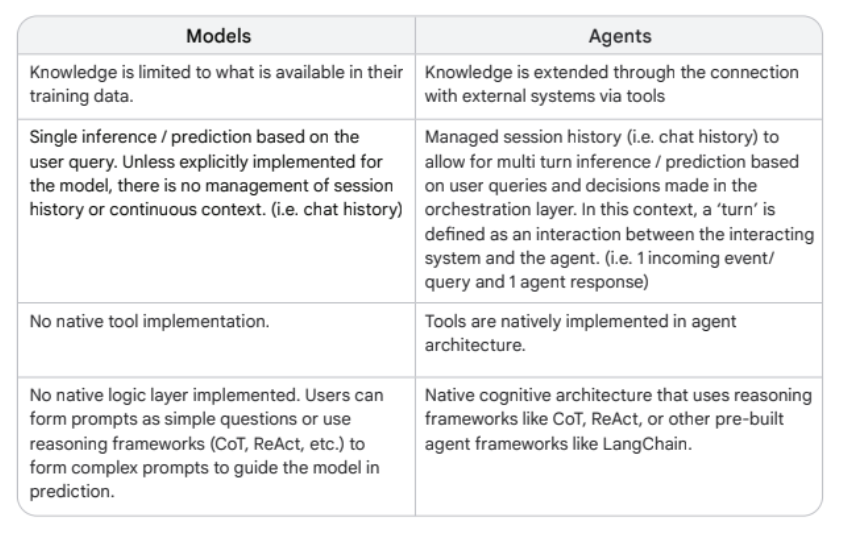
Reasoning Frameworks
ReAct
This is a prompt engineering framework for taking action on user query with or without in-context examples.
Chain-of-Thought
Reasoning through intermediate steps. Flavors include:
- Self-consistency
- Active-prompt
- Multimodal CoT
Tree-of-Thought
Suited for exploration or strategic look-ahead. This generalizes over CoT prompting and lets the model explore various thought chains.